Six numbers decide everything. Two quotes for "50 mm football turf" can be ₹60 and ₹90 per sq ft and both be honest, because the pile height is the least informative line on the sheet. Here is what to read instead.
Dtex.
The weight in grams of 10,000 metres of yarn. 12,000 dtex means the yarn is 1.2 g per metre. Heavier yarn is thicker and more resilient, takes more stud impact, and lasts longer. Football turf runs 12,000 to 18,000. Landscape grass is often 8,000 to 10,000 and should not be on a sports ground.
Pile height.
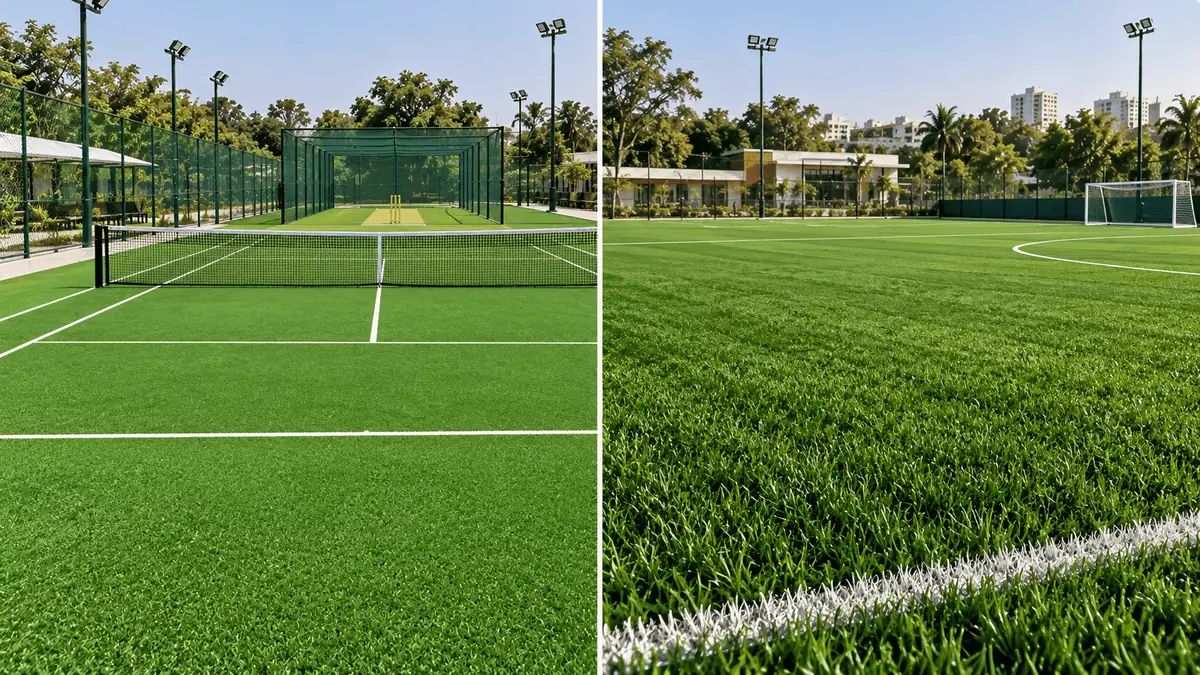
The length of the fibre above the backing. 50 mm is the football standard for infill systems; 40 mm for hybrid and multi-sport; 30 mm for non-infill; 15 mm for tennis; 9 mm for cricket pitches. Taller is not better; the right height depends on the sport and the infill.
Stitch rate and gauge.
Stitch rate is stitches per 10 cm along a row, written as 13/10 or 14/10. Gauge is the spacing between rows, usually 5/8 inch or 3/4 inch. Together they set how many tufts per square metre. More tufts hold infill better and wear slower.
Density.
Grams of yarn per square metre, the product of dtex, stitch rate, gauge and pile height. A 50 mm 14K turf at 13/10 on 5/8 gauge is around 8,200 g per sq m. Compare density across quotes; it is the single best proxy for how much turf you are buying.
Yarn type and shape.
Monofilament polyethylene is the sports standard; fibrillated yarn is used on tennis and older systems. Shape matters for resilience: C, S, diamond and stem profiles stand up better than flat tape. Dual-colour yarn, two shades of green in one tuft, hides wear and marks; single-colour is a landscape trait.
Backing.
Latex is standard and fine in most climates. Polyurethane is more stable in heat and damp and does not delaminate; specify it on coastal and humid sites. Drainage holes should be punched, not cut.
Certification.
FIFA Quality or Quality Pro on football systems, ITF classification on tennis, FIH category on hockey. The mark applies to a system, not a roll; ask for the lab report. See FIFA Quality vs Quality Pro.
The tiers on one page.
| Tier | Turf rate | Built for | Life |
|---|---|---|---|
| 12,000 dtex, Foundation | ₹60 to ₹68 / sq ft | Recreation and rental | 5 to 7 yr |
| 14,000 dtex, Performance | ₹68 to ₹76 / sq ft | Schools and academies | 8 to 10 yr |
| 16,000 dtex, Pro | ₹76 to ₹84 / sq ft | Clubs and tournaments | 6 to 10 yr |
| 18,000 dtex, Flagship | ₹84 to ₹90 / sq ft | Stadium, FIFA Quality Pro | 8 to 10 yr |
| 30 mm non-infill | ₹70 to ₹85 / sq ft | Rooftops and rentals | 5 yr |
Every product on the football page shows dtex, density, stitch rate and gauge on the card, so you can compare before you ask for a quote.
Questions, asked often.
Is higher dtex always better?
Heavier yarn lasts longer under heavy use. For a rooftop or a light-use ground, 12K or non-infill is the right money. Choose by hours of play.
What density should football turf have?
Around 8,000 g per sq m and up for 50 mm infill systems. Below 6,000 is a landscape product.
Why do two 50 mm turfs cost so differently?
Dtex, density, backing and certification. Read those four lines and the price difference explains itself.
Got a ground?
Site visit, spec sheet and a turnkey quotation in 48 hours.