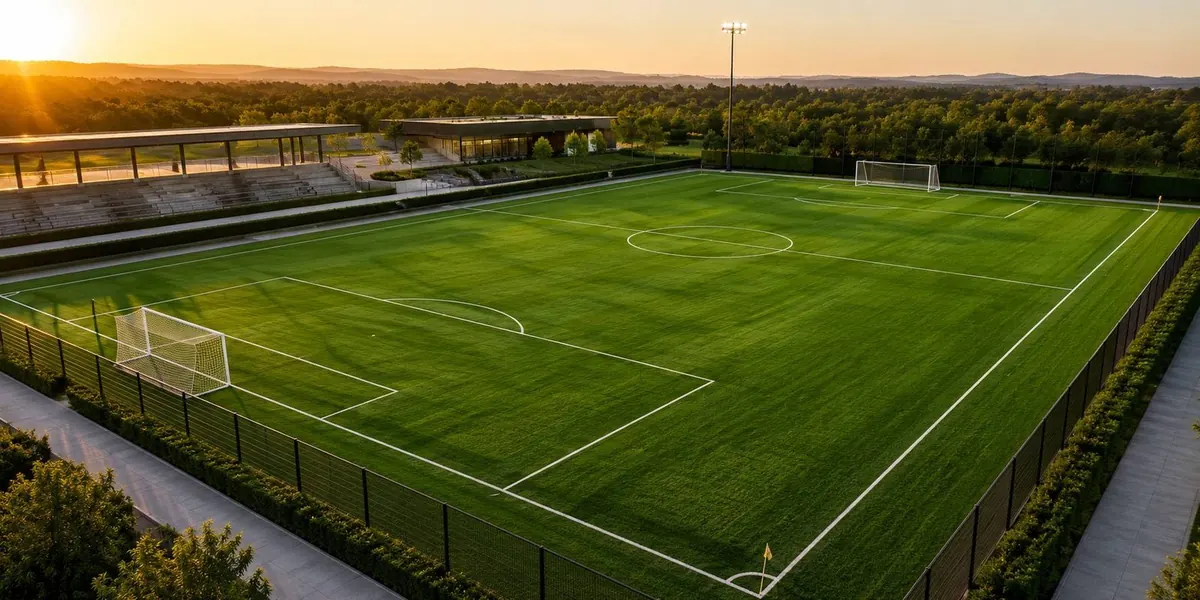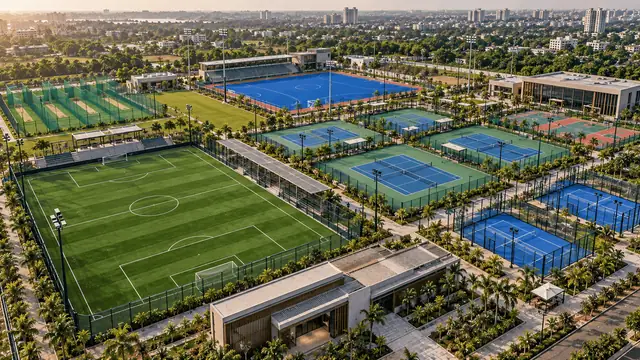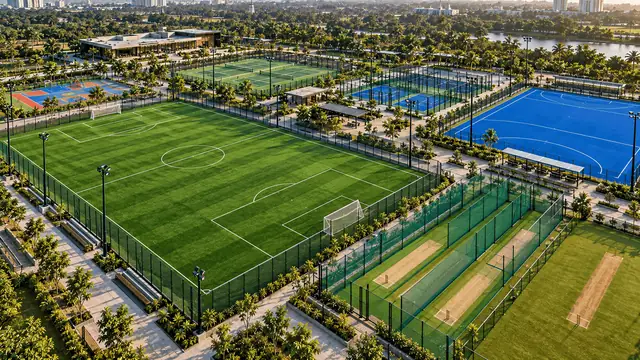
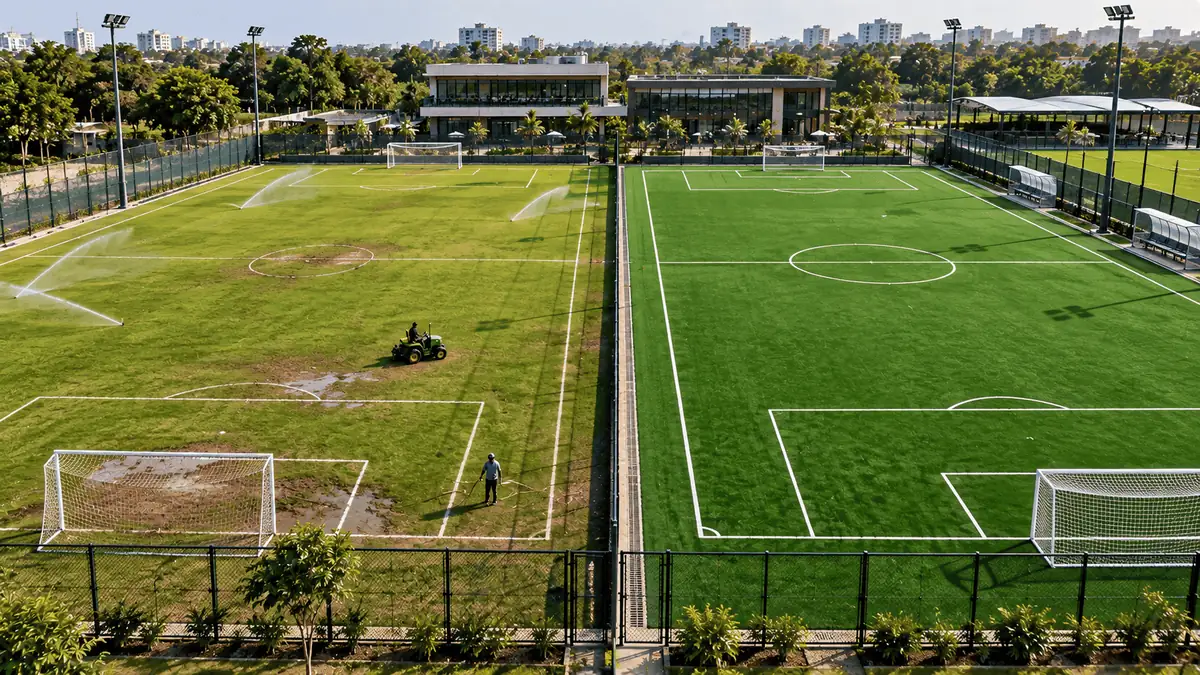
Short answer. Natural grass for a stadium with a groundskeeping team and a limited fixture list. Artificial turf for everything that has to play every day and through the monsoon. Hybrid, in the Indian sense of a 35 mm cricket-first turf, for grounds where cricket and football share the plot.
| Natural grass | Artificial turf | Hybrid turf (35 mm) | |
|---|---|---|---|
| Hours of play | 10 to 15 a week before it wears | Unlimited | Unlimited |
| Monsoon | Closed for weeks; mud | Plays within minutes on a drained base | Same |
| Summer heat | Dies without irrigation | Surface warms; evening play | Runs cooler than rubber-filled |
| Water | Thousands of litres a day | None | None |
| Staff | Groundsman, mowing, feeding, re-turfing | Brush and top-up | Brush and top-up |
| Build cost | Lower | Higher | Middle |
| Cost over 10 years | Highest | Lowest per hour played | Low |
| Feel | The reference | Close on FIFA systems | Firmer, cricket bounce |
Where grass wins.
A stadium that hosts twenty matches a year, has a groundskeeping crew and an irrigation budget, and wants the reference surface. Natural grass at that level is a beautiful thing and we do not pretend otherwise. It is also a full-time job and a seasonal one.
Where turf wins.
Everywhere the ground has to earn its keep. A school timetable, a rental ground, an academy, a society common area. Turf plays every day, in every month, without water or a groundsman, and over ten years costs a fraction per hour of play. The FIFA-tested systems are close enough to grass in feel that the difference is a talking point, not a complaint.
What "hybrid" means here.
In Europe, hybrid means natural grass reinforced with synthetic fibre, a stadium product. In India the word has come to mean a 35 mm sand-dressed synthetic turf built for cricket first and football second, the surface under most box cricket grounds. It is a good product for that job. It is not natural grass. See hybrid turf.
The heat question.
Artificial turf does get hotter than grass in direct sun. On a rubber-filled pitch the afternoon surface in a hot city is uncomfortable, which is why most grounds run evening bookings and why sand-dressed and lighter-infill systems exist. It is a scheduling issue, not a safety one, and every operator in the country manages it.
Questions, asked often.
Is artificial turf bad for the environment?
It uses no water, no fertiliser and no mowing for ten years, then the carpet is recyclable. Natural grass in an Indian city uses thousands of litres a day. Neither is free; turf is lighter over its life.
Do injuries increase on turf?
On FIFA-tested systems the injury rates are comparable to good grass; the tests exist for that reason. Poorly built pitches, hard and bare, are the ones that hurt.
Can I convert a grass ground to turf?
Yes. The grass and topsoil are stripped, a base is built, and turf is laid. See how a turf is built.
Got a ground?
Site visit, spec sheet and a turnkey quotation in 48 hours.