
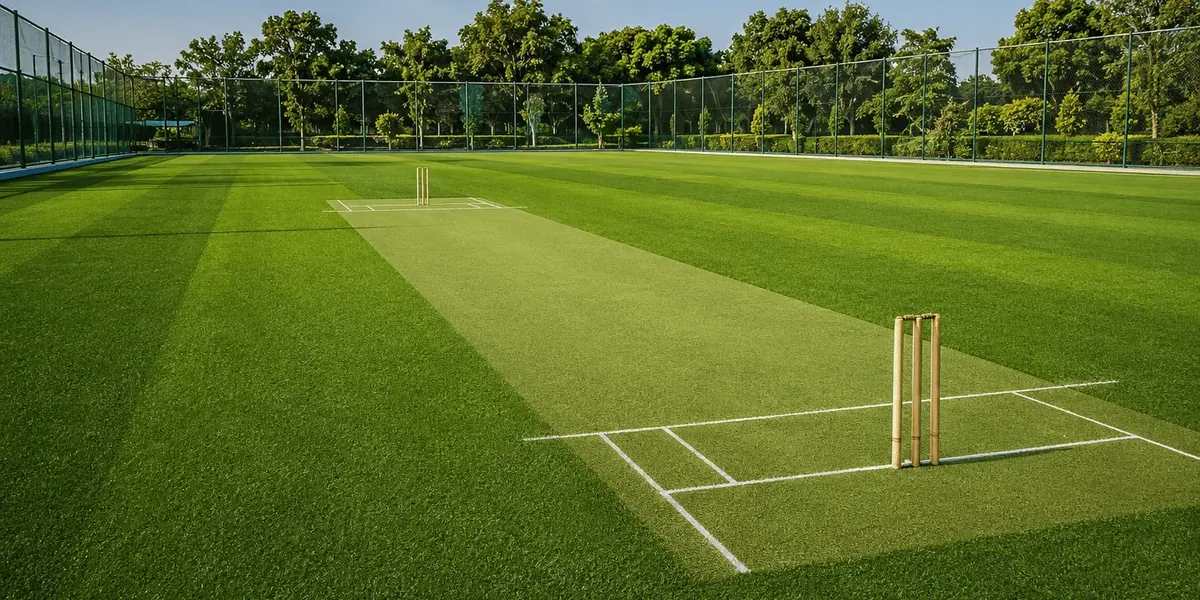
Cricket turf.
A 9 mm dense-pile playing strip for true bounce, with 35 mm sand-dressed outfield turf around it. Now in beige as well as green. Built for clubs, academies, schools and indoor nets.
Pitch and outfield.
A cricket ground is two surfaces. The strip has to give the ball a true bounce; the outfield has to keep the roll honest and take boots all day. We supply both, and they are different products.
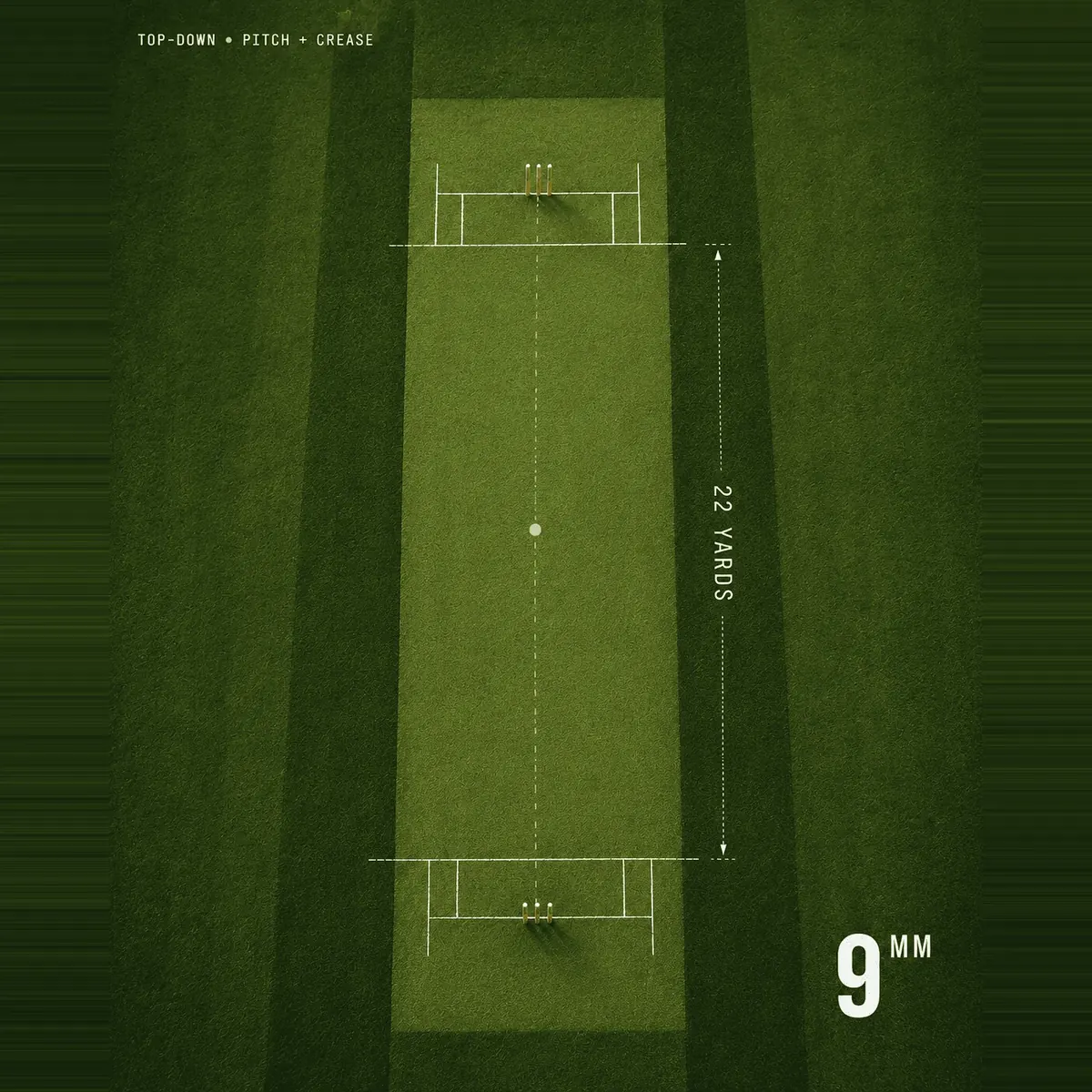
9 mm Cricket
Dense, short pile for the strip. True bounce, predictable seam, very little ball skid. Takes a bowling machine season after season.
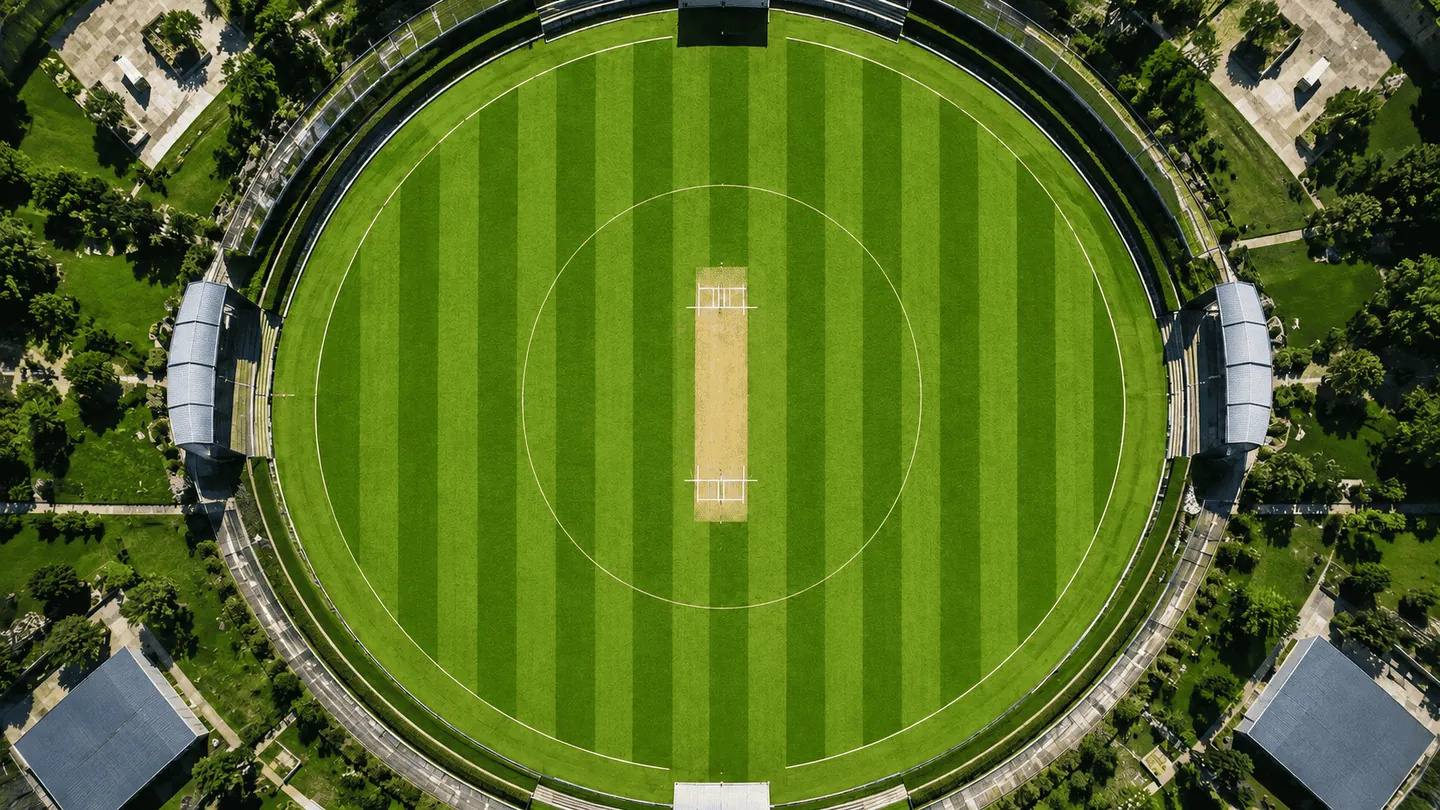
Outfield grass
35 mm hybrid turf for the outfield and box grounds. Dual-tone, sand-dressed, keeps the roll true and doubles for football.
Two colours for the strip.
The 9 mm strip now comes in beige as well as green. Same yarn, same 8,800 dtex, same 71,400 stitches per square metre. Only the colour changes, so the bounce and carry are identical either way.
The standard strip. Two-tone green that reads as a maintained square from the boundary, and hides ball marks on a busy ground.
A sand-toned strip that looks like a rolled natural wicket against a green outfield, so the square reads the way players expect. Popular for match grounds and anywhere the pitch is photographed.
Ask for both in your sample pack and put them side by side before you decide. See the full specification on the 9 mm cricket page.
Why 9 mm, why dense.
Cricket asks a turf for things football does not. The ball has to grip the pile briefly enough to seam off the surface, then carry through to the keeper without dying. That needs a short pile and a very dense stitch. Anything taller and the ball gets eaten; anything sparser and the bounce turns random.
| Surface | Stitches / m² | What the pile is for |
|---|---|---|
| Football | 8,820 | Long pile, sparse, for slide and cushion |
| Padel | 46,200 | Mid-range, for grip and glide |
| Cricket, ILAN 9 mm | 71,400 | Short and dense, for a true bounce |
Our cricket pile is 9 mm tall, stitched at 34 per 10 cm on a 3/16 inch gauge, which packs in 71,400 stitch points per square metre.
Four roll sizes.
From a single practice strip to a full club pitch. All four rolls share the same yarn, density and backing. Only the size changes.
215 sq ft. About one net strip.
430 sq ft, 120 kg. Indoor net.
323 sq ft. About a twin practice strip.
646 sq ft, 180 kg. Full pitch.
Which one is yours?
Practice all year on a concrete or wood sub-base. The 9 mm pile shrugs off bowling-machine wear. Usually the 2 × 20 m roll.
A match-grade strip on a prepared sub-base with a multi-sport outfield around it, built to host weekly fixtures. Usually the 3 × 20 m roll.
Twin or triple practice strips with a shared outfield. We mix roll sizes to fit your footprint without wasting seam.
Base, turf and nets.
A cricket surface is only as true as what sits under it. ILAN builds the base, lays the turf and puts up the nets, so one team owns the levels, the drainage and the bounce.
Cut to formation level, proof-rolled, graded to 0.5 to 1 percent falls so water leaves the ground rather than pooling on it.
Granular sub-base 150 to 200 mm and wet-mix macadam 100 to 150 mm, compacted in layers and tested for density.
Dense asphalt 40 to 50 mm or PCC, laid to a 3 mm over 3 m flatness tolerance. The strip needs a rigid base for consistent bounce.
Perimeter drains, catch pits and kerbing, so the surface stays dry and the edges hold for years.
The details.
What comes with the turf
12 kg glue plus 1.2 kg hardener, 90:10 mix, 60-minute pot life.
0.3 m × 100 m roll.
Engineered grain, the stabiliser for the pitch system, A4Q.
10 m × 30 m, braided, knotless or twisted for the surrounds.
How to look after the pitch
A cricket surface has to stay predictable, which means keeping the pile upright and the strip clean.
Sweep or blow leaves and debris off the surface. Grit left to sit is what abrades the fibre.
Brush the pile upright along the routes that get walked most, and rinse to clear dust.
Check infill depth and top up where it has migrated. Inspect seams and edges for lifting.
Spot-clean spills. Damage is repaired by cutting out and re-joining a patch rather than replacing the field.
Questions people ask before buying
Does it come with batsman and bowling-side markings?
What pile height should a cricket pitch be?
Do we need a concrete base under the pitch?
Can it take a bowling machine?
Indoor nets or outdoor, is the surface different?
How many practice lanes fit in a given space?
Do you do the nets and cages too?
How is a cricket surface maintained?
Can we mark it for other sports?
The rest of the ILAN range.
One partner for every surface, sports turf, courts, tracks, landscape grass and the netting that finishes a ground.
Got a ground?
Let's measure.
Site visit · pitch + outfield layout · turnkey quotation in 48 hrs
Request a quote