

EPDM athletics surfacing built to World Athletics geometry. Spray coat for schools and training, sandwich or full PU for competition.
Also in EPDM: playground surfacing · granules and the colour mixer
Both are EPDM-topped rubber track systems. The difference is the build underneath, and that decides drainage, durability and cost.
A 10 mm base mat of black SBR rubber granules bound in PU, finished with a 3 mm sprayed top coat of PU mixed with fine EPDM granules. The textured, permeable surface drains freely and gives a durable, cushioned run at a lower cost, the practical choice for school and training tracks.
The classic “sandwich” build, an SBR base, sealed with a PU intermediate layer, then EPDM granules broadcast and locked into a PU wearing course. A denser, impermeable surface with excellent energy return and durability, suited to competition-grade athletics tracks.
A solid polyurethane track cast in place, no rubber granule base. Successive PU layers are poured and self-levelled, then finished with a structured spray or textured wearing course. The result is the densest, most uniform surface of the three, with the highest energy return and the tightest tolerances, the specification for elite competition venues.
The traditional athletics red is standard, with lane and infield zones available across the full 21-colour EPDM range.
Full 21-colour EPDM range · final colours confirmed on order
EPDM track surfacing is specified across a wide range of athletics facilities, the system and lane count change, the build does not.
Side by side, so the decision is made on performance rather than price alone.
Thicknesses shown are typical for a 13 mm build, final specification confirmed per project.
A track is a survey problem before it is a surfacing problem. These are the layouts we are most often asked to build.
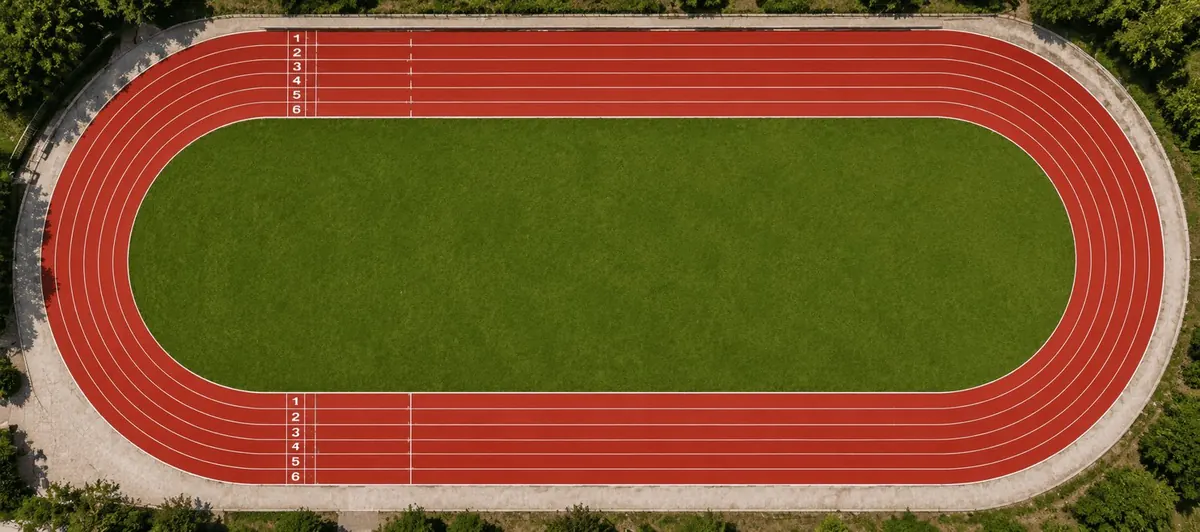
The reference layout: a 400 m oval with 84.39 m straights, a 36.50 m bend radius and lanes 1.22 m wide. Final setting-out is always confirmed by survey against the actual plot.
Where land is tight, 6-lane ovals and reduced-perimeter loops are common. The oval still needs to close correctly, that is a survey question before it is a surfacing question.
Sprint straights, hurdle lanes and jump run-ups are laid to the same build as the oval and are often the first phase of a staged facility.
ILAN builds to IAAF, now World Athletics, geometry. A competition-certified facility additionally requires measurement and certification by an accredited surveyor, arranged separately.
/ On site
The full sequence a turnkey track follows. The base stages matter more to the finished result than the rubber ones do.
Survey and setting-out
The plot is surveyed and the oval set out. Falls, levels and the drainage route are established before anything is laid, because a track that does not drain will not last whatever goes on top.
Base check
The bituminous or concrete base is laid to fall by our civil team. That layer carries the loads; the rubber only provides the surface, so we check it before we start.
Base curing and check
Once the base has cured we check it for level tolerance and ponding. Corrections happen here, not after the rubber is down.
SBR base layer
Black SBR rubber granules mixed with binder and laid to the specified depth, then compacted and cured. This is the cushion.
EPDM wear layer
Either sprayed as a fine EPDM finish, or laid as a bound EPDM wear layer, depending on the system chosen.
Curing
The surface is left to cure fully before it takes any load. Rushing this stage is the most common cause of early failure.
Line marking
Lanes, staggers, exchange zones and event markings set out and painted to standard geometry.
Handover
Surface inspected, markings checked, and a care brief handed over with the facility.
/ Care & lifecycle
A rubber track rewards very little maintenance, but it does need the little it asks for.
Sweep or blow debris off the surface. Grit left on a track acts like sandpaper under spikes.
Wash down to clear dust and prevent surface algae, particularly on shaded bends.
Inspect for lifting edges, blistering or worn patches, especially at lane 1 on the bends and in the exchange zones, which take the most punishment.
Localised repairs are made by cutting out and re-laying the affected patch. A tired but sound track can often be re-topped rather than rebuilt.
/ What drives the price
Two tracks of the same length can quote very differently. These are the variables that move the number.
Send length, lane count and a photo of the existing ground and we will come back with a surveyed, turnkey quotation.
Base construction · Track & rubber systems
A surface is only as good as what it sits on. ILAN now builds the base as part of the project, so one team owns levels, drainage, tolerances and the surface on top. Layer thicknesses are finalised after our site survey and soil check.
Formation graded to inward falls so water runs to the inner drain, never across lanes.
GSB and WMM compacted in layers, tested, with the camber built in from the first layer.
Two-layer bituminous base, binder course plus wearing course, flat to tolerance before the rubber system goes down.
Inner-edge drain, catch pits and concrete kerbs to hold the track edge and the rubber build-up.
Base, surface and marking · one scope · one price
Tell us the length, lanes and system, we’ll survey and quote it turnkey.