
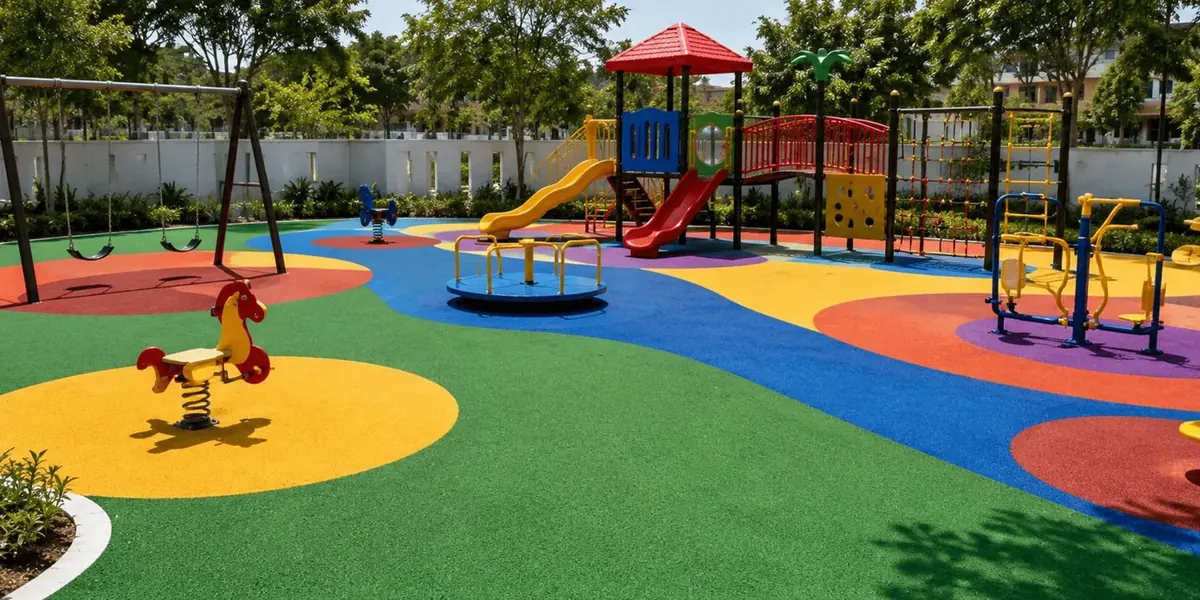
Seamless wet-pour EPDM safety surfacing, poured in place to the EN 1177 fall height your equipment needs. Any colour, any shape, any graphic.
A cushioning base of SBR rubber is laid to the depth the fall height requires, then topped with a coloured EPDM wear layer, both mixed on site with PU and troweled seamlessly around every post and edge. The result is one continuous, joint-free, impact-absorbing surface.
A resilient base of black SBR rubber granules, laid thicker where the equipment is taller, this is the layer that absorbs the fall.
A 10 mm coloured EPDM top layer that takes the wear and carries the colour, UV-stable, slip-resistant and ready for graphics or number games.
The total thickness is set by the critical fall height (CFH) of the tallest equipment. We build up to suit, indicative guide below; final build confirmed against your equipment.
Because it’s poured on site, the surface can be any colour blend and any shape, hopscotch, roadways, number grids, logos and play graphics inlaid straight into the floor.
Full 21-colour EPDM range · custom blends & inlaid graphics on request
Every other decision on a playground surface follows from this one. It is worth understanding before you specify.
The critical fall height is the height from which a fall onto the surface has been tested to produce an acceptable impact result. It is not a guess, it is the number the surface build is designed to meet.
CFH is driven by the free-fall height of the tallest equipment in the zone: the highest point a child can stand, sit or hang from. That single number decides the depth of the SBR cushion beneath the EPDM.
A taller slide or climbing frame needs a deeper cushioning layer to absorb the same impact. This is why our thickness range runs from 25 mm up to 45 mm and beyond rather than being one standard build.
EN 1177 is the European standard for impact-attenuating playground surfacing and the reference our builds are specified against. Test certification for a specific installation is arranged on request.
/ Compared
The honest comparison, including where the alternatives have a case.
/ Design & graphics
Because it is poured rather than laid in units, the design is limited by the drawing rather than by the product.
The full EPDM palette is available, and colours can be blended within a single pour to create gradients, zones or brand-matched areas.
Shapes, numbers, animals, hopscotch grids, running tracks, sports circles and logos are inlaid into the wear layer rather than painted on, so they wear with the surface instead of off it.
Different colours are used to separate toddler zones, active play and quiet areas, a design tool and a supervision aid at the same time.
Because the surface is poured, it can be troweled to any curve, around any post, and finished against any edge detail without a cut line.
/ On site
The sequence a turnkey playground surface follows, from equipment schedule to handover.
Fall-height assessment
We take the equipment schedule and the free-fall height of every item, then set the required CFH for each zone. This decides the build before anything else does.
Base check
We build a free-draining base, usually permeable macadam or a concrete slab, and confirm it is suitable before we pour.
Edge restraint
Perimeter edging is set to contain the pour and give the surface a clean, durable termination.
SBR cushion layer
Black SBR granules mixed with PU binder on site and laid to the depth the assessed fall height requires, then compacted level.
EPDM wear layer
Coloured EPDM granules mixed with binder and troweled over the cushion in one continuous pass, around posts, into corners, with no joints anywhere.
Graphics inlay
Where the design calls for it, shapes and games are cut and inlaid into the wet surface while it is still workable.
Curing
The surface is closed off and left to cure. It must not take foot traffic before it has.
Inspection and handover
Levels, edges, thickness and finish checked, then the area is handed over with a care brief.
/ Care & lifecycle
A poured surface asks for very little, but the little it asks for keeps it looking new.
Sweep leaves and grit off the surface and clear anything caught at the edges.
Rinse down with water. The surface is free-draining, so washing carries dust straight through rather than pooling it.
Check for wear at the highest-traffic points, slide exits, swing landing zones and gate entries, and for any lifting at edges or around posts.
Damage is repaired by cutting out the affected area and re-pouring. Because the surface is bonded and seamless, a well-made repair blends rather than patches.
/ Scope of supply
A turnkey playground surfacing quotation normally includes:
Base construction · Track & rubber systems
A surface is only as good as what it sits on. ILAN now builds the base as part of the project, so one team owns levels, drainage, tolerances and the surface on top. Layer thicknesses are finalised after our site survey and soil check.
Formation graded to inward falls so water runs to the inner drain, never across lanes.
GSB and WMM compacted in layers, tested, with the camber built in from the first layer.
Two-layer bituminous base, binder course plus wearing course, flat to tolerance before the rubber system goes down.
Inner-edge drain, catch pits and concrete kerbs to hold the track edge and the rubber build-up.
Base, surface and marking · one scope · one price
Send us the area and the equipment fall heights, we’ll spec the build and quote it turnkey.