
A 9 mm dense-pile cricket surface for the playing strip, 8,800 dtex monofilament at 71,400 stitches/m² for true bounce, predictable carry and low ball-skid. Built to shrug off bowling-machine wear, season after season.
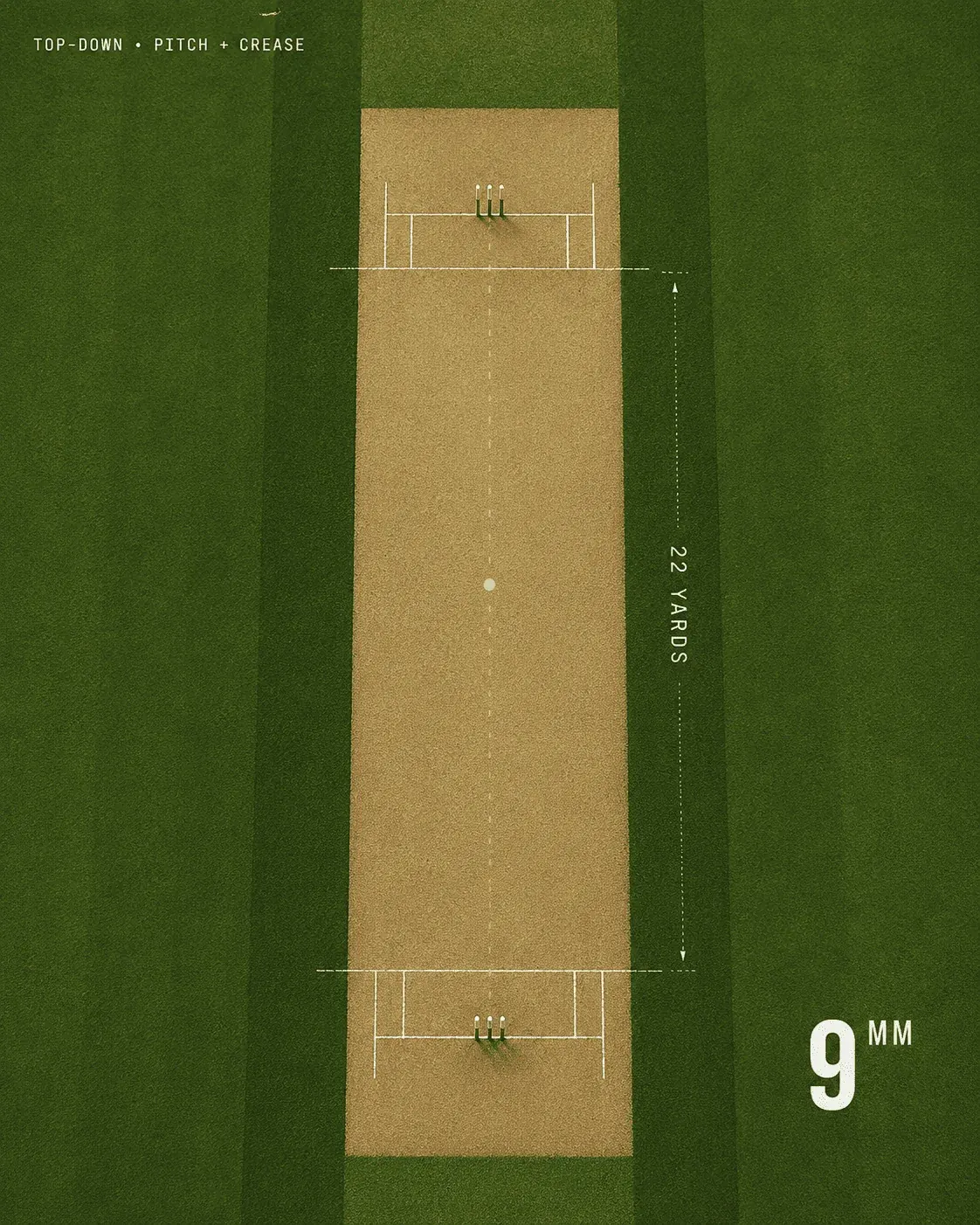
Top-down · pitch + crease · 22 yards
Dense, short and stiff. A tightly-packed 9 mm monofilament pile gives a firm, even top surface, so the ball bounces true and carries predictably, with very little skid variance ball to ball.
8,800 dtex at 71,400 stitches/m² packs the strip densely enough to take repeated bowling-machine and net wear without matting, the surface stays flat and consistent across a full season.
SBR / PU backing locks the tufts and, with an unfilled dense pile, drains quickly and washes clean, no infill to top up, no rubber to migrate.
A dense 9 mm cricket strip built for true bounce and predictable carry, ideal for practice nets, club and academy pitches and full match grounds that see heavy, repeated wear.
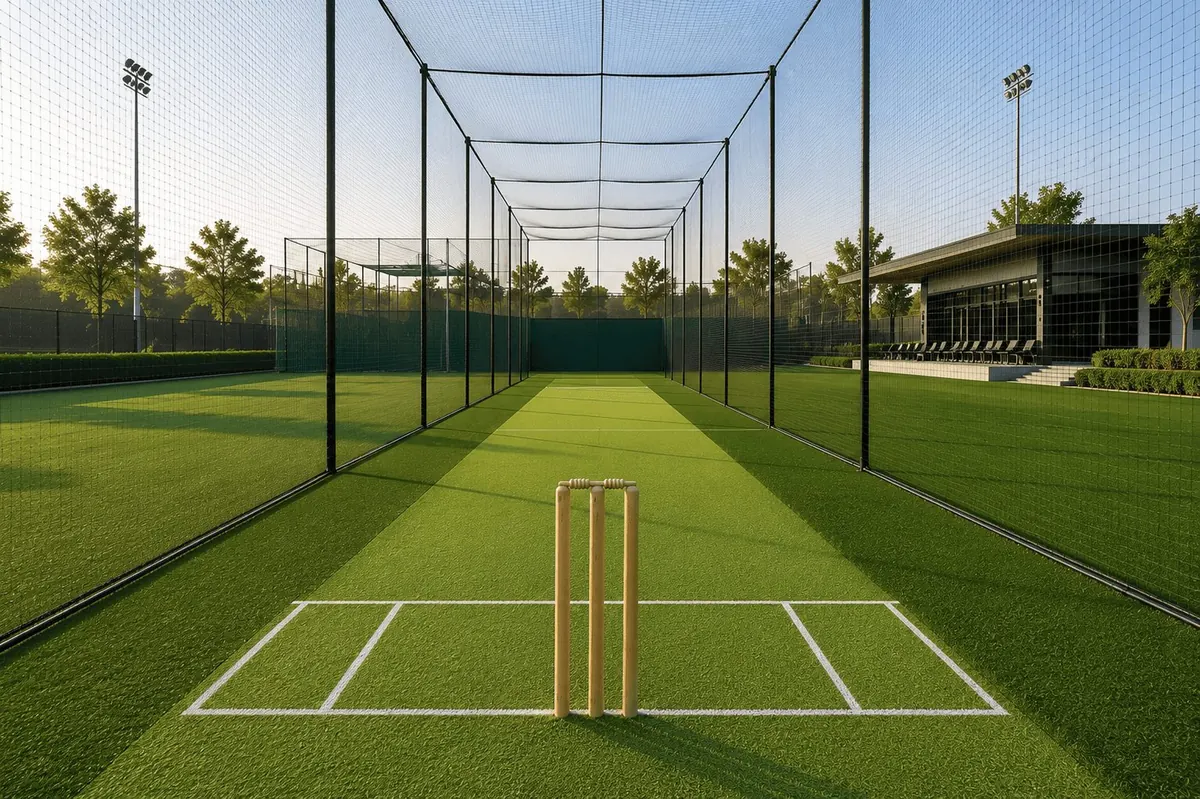
Indoor and outdoor nets that take daily bowling-machine and throw-down wear without going flat.
Match and practice strips for clubs and coaching academies that need a true, consistent bounce.
Full centre strips and farmhouse pitches where a dependable, low-maintenance surface beats natural turf.
Manufacturer-backed warranty against defects in materials and UV degradation, supplied and installed turnkey by ILAN.
Typical playable life under normal cricket use with occasional brushing and washing.
≥180 mm/h permeability keeps the pitch playable through monsoon downpours with minimal standing water.
The 9 mm strip is now available in beige as well as green. Same yarn, same 8,800 dtex, same 71,400 stitches per square metre, so bounce and carry are identical either way.
The standard strip, two-tone green. Reads as a maintained square from the boundary and hides ball marks on a busy ground.
A sand-toned strip that looks like a rolled natural wicket against a green outfield. Popular for match grounds and anywhere the pitch is photographed.
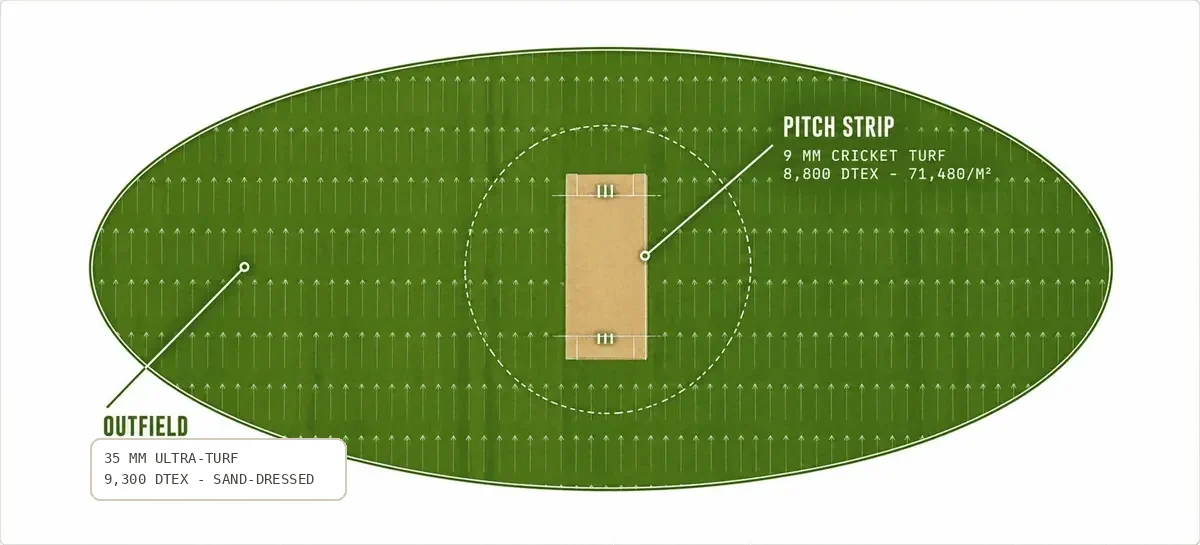
Full-ground layout, 9 mm pitch strip in a 35 mm Ultra-Turf outfield.
Full data sheet for the 9 mm dense-pile cricket turf, as supplied and installed by ILAN. Tolerances per the relevant ISO test methods.
The manufacturer reserves the right to alter specifications to improve the system per the latest standards. Values are nominal manufacturer data.
ILAN supplies and installs. On a cricket surface the base decides bounce, so the base stages matter most.
Site survey and levels
We survey the area, check falls and confirm the sub-base. For a playing strip, flatness tolerance is the single most important measurement on the job, bounce consistency comes from the base.
Base check
The strip needs a rigid prepared base for consistent bounce; the outfield can sit on compacted aggregate. We build both: the base is specified at survey, constructed by our civil team and checked before laying.
Base curing and check
Once the base has cured we check it for level and ponding. Any correction happens at this stage, because nothing above will fix a base that is out.
Rolling out and acclimatising
Rolls are set out with pile direction planned along the length of the strip and left to relax before cutting.
Jointing
Seams joined on jointing tape with adhesive, pile matched across each joint. On a playing strip a raised joint is a bounce defect, not just a cosmetic one.
Line marking
Creases and return creases marked to standard dimensions.
Infill and brushing
Sand dressed to the specified rate where the system calls for it, then power-brushed to lift the pile and settle infill evenly.
Inspection and handover
Levels, joints and markings checked, then handover with a care brief.
A cricket surface has to stay predictable, which means keeping the pile upright and the strip clean.
Sweep the strip clear of grit and debris. Anything sitting on a cricket surface affects bounce immediately.
Brush the pile upright along the length of the strip, concentrating on the bowling and batting ends.
Check infill where specified and top up. Inspect joints and the strip edges for lifting.
Bowling-machine and practice wear concentrates in small areas, those patches are cut out and re-laid rather than replacing the strip.
Because bounce has to be predictable. A short, dense pile at 8,800 dtex and 71,400 stitches/m² gives true bounce and consistent carry. A taller pile absorbs and deadens the ball, which is exactly what you do not want on a playing strip.
The playing strip normally does, because rigid support is what delivers consistent bounce. The outfield can sit on a compacted aggregate base. The exact build is confirmed at survey against how the ground will be used.
Yes, that is what the dense 9 mm pile is specified for. Machine wear concentrates in a small area, so expect that zone to show use first and plan for a patch repair rather than a full relay.
Different surfaces doing different jobs. The strip is this 9 mm dense cricket pile. The outfield normally uses a taller multi-sport pile. Mixing the two correctly is what makes a ground play properly.
The turf specification is largely the same; the base and surround change. Indoor sits on a rigid floor with netting and impact walls; outdoor needs drainage and weather-facing fixings.
It depends on run-up length and safety margins between lanes rather than raw area. Send the dimensions and we will lay it out.
Yes. We supply and install sports netting, perimeter nets, practice cages and dividers, and can supply them with the surface as one scope.
Typical service life is 6–8 years, driven by playing hours, sun exposure and whether the surface is swept and brushed. Bowling-machine zones wear first and are repaired in place.
Base construction · Turf systems
A surface is only as good as what it sits on. ILAN now builds the base as part of the project, so one team owns levels, drainage, tolerances and the surface on top. Layer thicknesses are finalised after our site survey and soil check.
Cut to formation level, proof-rolled, graded to the designed falls (0.5–1%) so water leaves the field, never pools on it.
Granular sub-base (GSB) 150–200 mm and wet-mix macadam (WMM) 100–150 mm, compacted in layers and tested for density.
Dense asphalt 40–50 mm or PCC, laid to a 3 mm over 3 m flatness tolerance, with shock pad where the system calls for it.
Perimeter drains, catch pits and kerbing, so the surface stays dry and the edges hold for years.
Base, surface and marking · one scope · one price
Site visit, spec sheet, and a turnkey quotation within 48 hours, supply or supply-and-install, anywhere in India. ILAN supplies and installs cricket surfaces turnkey.